
Enterprise AI procurement is defined as the structured process of evaluating, contracting, and integrating AI systems across an organization's technology and governance infrastructure. Done well, it produces a single cross-functional artifact covering vendor evaluation, regulatory compliance, and operational readiness within an 8 to 10 week cycle. Done poorly, it generates fragmented documentation, hidden architectural debt, and regulatory exposure that surfaces months after signing. This guide covers the six-stage framework, team composition, RFP scoring, and governance practices that make AI sourcing in enterprise environments work at scale.
What are the essential stages in an AI procurement process?
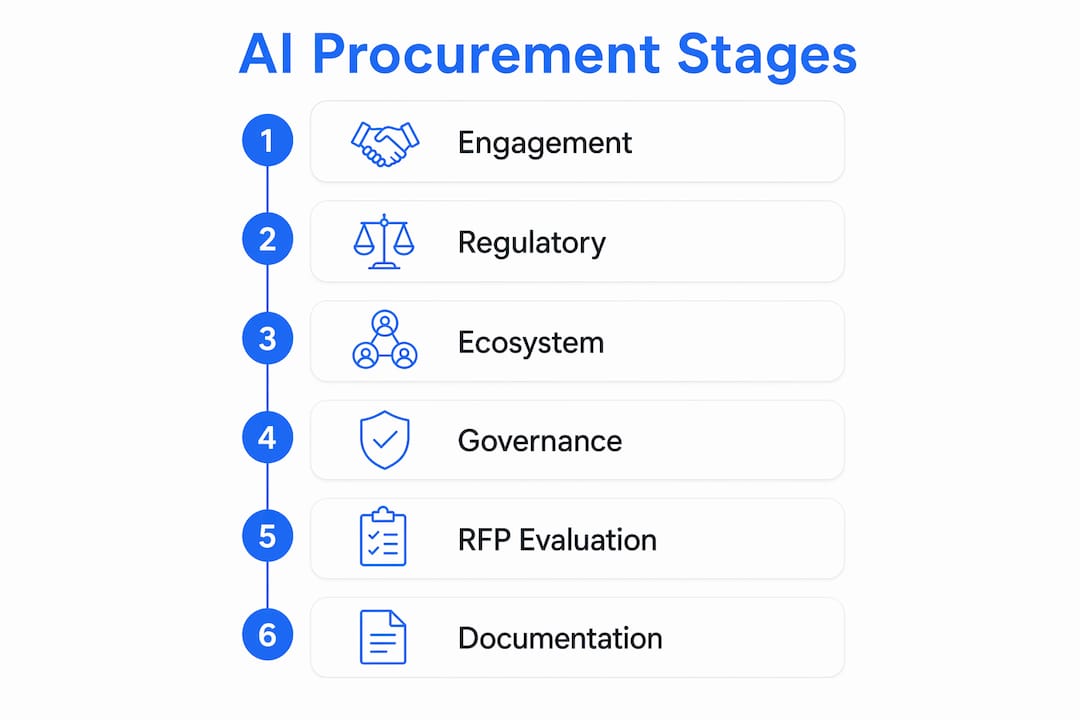
A structured AI procurement process follows six stages in a fixed sequence. Improper sequencing produces inconsistent compliance documents that cannot be reconciled after the fact, which is why order matters as much as content.
Stage 1: Engagement classification and build-vs-buy analysis. Before any vendor conversation begins, the team defines whether the use case requires a custom-built model, a fine-tuned open-weight model, or a third-party solution. This classification determines the procurement track and the regulatory filters that apply downstream.

Stage 2: Regulatory rule-out. Compliance filters are applied early, not at contract review. EU AI Act Article 9 requirements, data residency rules, and sector-specific regulations are mapped against the use case. Compliance artifacts assembled during this stage feed directly into the final contract attachment, avoiding redundant documentation work later.
Stage 3: Ecosystem-fit classification. The team evaluates how the AI system integrates with existing platforms, data pipelines, and identity infrastructure. This stage surfaces integration blockers before the RFP goes out, preventing vendors from overpromising on compatibility.
Stage 4: Cross-functional GAUGE governance benchmark scoring. A structured scoring session brings together architecture, security, legal, and business stakeholders to evaluate governance posture against a shared rubric. This session is not a formality. It is a procurement signal that reveals whether the organization has the internal clarity to manage the vendor relationship post-deployment.
Stage 5: Weighted vendor RFP evaluation. Written responses are scored using a weighted rubric before any demo is scheduled. The RFP evaluation window runs approximately two weeks, with live vendor conversations used only to verify written claims.
Stage 6: Documentation consolidation. All outputs from stages one through five are consolidated into a single compliant contract attachment and audit artifact. This document satisfies procurement, legal, and regulatory review in one pass.
Pro Tip: Schedule the GAUGE governance scoring session before issuing the RFP. The gaps your team identifies internally will directly sharpen the questions you ask vendors.
| Stage | Primary output |
|---|---|
| Engagement classification | Build-vs-buy decision memo |
| Regulatory rule-out | Compliance filter checklist |
| Ecosystem-fit classification | Integration requirements document |
| GAUGE governance scoring | Cross-functional benchmark scorecard |
| Weighted RFP evaluation | Scored vendor comparison matrix |
| Documentation consolidation | Single compliant procurement artifact |
Which team roles are necessary for successful AI procurement?
Successful AI procurement requires three to five specialized internal practitioners managing governance, architecture, and risk alongside the procurement function. This is not a procurement-only exercise, and treating it as one is the most common structural mistake enterprises make.
The core team should include a technical architect who owns integration and infrastructure requirements, a governance or risk officer who maps regulatory obligations, and a legal representative who reviews contractual protections. Platform engineering, finance, and the business sponsor round out the group. Each role contributes a distinct lens that the others cannot replicate.
- Technical architect: Evaluates API compatibility, model performance benchmarks, and infrastructure requirements
- Governance or risk officer: Applies EU AI Act Article 9, GDPR, and sector-specific compliance filters
- Legal counsel: Reviews data training opt-in clauses, change-of-law provisions, and audit rights
- Platform engineer: Assesses deployment complexity, latency requirements, and failover design
- Finance representative: Models total cost of ownership across a three-year horizon, not just year-one license fees
- Business sponsor: Defines success criteria and owns the use case definition from stage one
Skipping the cross-functional scoring session in stage four is a procurement risk, not just a process shortcut. When governance and architecture teams do not score vendors together, the resulting artifacts reflect different assumptions and cannot support a unified compliance review. The enterprise AI onboarding guide from Deepour covers how to structure these sessions for teams that are assembling this function for the first time.
Pro Tip: Assign a single procurement lead who owns the master artifact document. Without one owner, consolidation in stage six becomes a negotiation between departments rather than a documentation task.
How to structure and score AI vendor RFPs
Weighted RFP scoring rubrics prioritize production track record at 30% and data governance methodology at 20%, with change management weighted equally at 20%. Total cost of ownership accounts for 15%, and integration plus operational maturity split the remaining 15%. This weighting reflects what actually predicts production success, not what looks impressive in a demo.
Demos mask architectural debt and integration complexity by design. A vendor's demo environment is optimized for the demo. It does not reflect the latency, error handling, or data pipeline behavior your team will encounter in production. Schedule demos only after written RFP responses have been scored, and use them exclusively to verify specific claims from the written submission.
Key RFP sections to include
Your RFP should cover five content areas: technical architecture and model provenance, compliance and security posture, operational maturity and support SLAs, commercial terms and TCO modeling, and change management methodology. Each section should require written evidence, not narrative descriptions. Ask for red team reports, incident post-mortems, and reference contacts from production deployments at comparable scale.
Contractual protections that matter
Four clauses separate a well-structured AI contract from a standard software agreement. A data training opt-in clause prevents your data from being used to train the vendor's models without explicit consent. A change-of-law provision requires the vendor to notify you and adapt when applicable regulations change. A kill switch clause gives you the right to suspend the system immediately if a compliance or safety issue is identified. A data exit clause guarantees you can retrieve your data in a portable format within a defined timeframe.
Pro Tip: Request a completed model governance checklist from every vendor as part of the RFP response. Vendors who cannot complete it are telling you something important about their production readiness.
| Evaluation factor | Weight | What it measures |
|---|---|---|
| Production track record | 30% | Deployments at comparable scale with verifiable references |
| Data governance methodology | 20% | Data handling, lineage, and consent practices |
| Change management | 20% | Vendor support for adoption, retraining, and iteration |
| Total cost of ownership | 15% | Three-year cost including inference, tuning, and governance |
| Integration and operational maturity | 15% | API stability, SLA history, and support structure |
What operational best practices optimize AI procurement outcomes?
AI procurement automation software improves cycle time and compliance adherence, but only when workflow mapping and policy codification precede the tooling decision. Buying automation before defining your policy contracts is the operational equivalent of automating a broken process.
Start by mapping every current procurement workflow at the task level. Identify where approvals stall, where documentation is duplicated, and where compliance checks happen too late to change outcomes. These are the points where automation creates durable value. Workflows that are not mapped cannot be governed, and workflows that are not governed produce the inconsistent artifacts that derail procurement reviews.
- Define policy contracts for routing, approvals, and escalations before selecting any automation tool
- Set KPIs that measure cycle time, compliance quality scores, savings against TCO projections, and risk escalation precision
- Use privacy-first desktop workspaces for RFP drafting and negotiation preparation to prevent accidental leaks of sensitive procurement data
- Adopt modular architecture in your AI infrastructure so individual components can be updated or replaced without disrupting the full stack
- Schedule quarterly compliance reviews tied to the change-of-law clauses in your contracts, not just annual audits
Pro Tip: Build your KPI dashboard before the procurement track starts, not after. Measuring cycle time and compliance quality from week one gives you the data to defend your process to leadership and improve it for the next acquisition.
What are common challenges in AI procurement?
Enterprise teams encounter five recurring obstacles when executing AI procurement at scale. Each one is preventable with the right process design.
-
Siloed reviews. When regulatory, security, and procurement teams conduct separate evaluations, the resulting compliance artifacts reflect different assumptions. Consolidated procurement tracks running eight to ten weeks resolve this by forcing cross-functional alignment into a single artifact.
-
License fee myopia. Most enterprises evaluate AI deals by year-one license fees, ignoring inference costs, fine-tuning expenses, and governance overhead that frequently exceed initial spend within 18 months. TCO modeling over a three-year horizon is not optional.
-
Skipped governance scoring. Teams that bypass the GAUGE benchmark session in stage four discover governance gaps during contract review or, worse, during a regulatory audit. The session is not overhead. It is risk mitigation.
-
Demo-driven selection. Enterprise buyers who focus on platform capabilities rather than delivery track record consistently overestimate production readiness. Written RFP responses with verifiable references are a better predictor than any live demonstration.
-
Missing contractual protections. Contracts without change-of-law provisions and audit rights leave enterprises exposed when regulations shift. The EU AI Act Article 9 compliance requirement alone creates ongoing obligations that standard software contracts do not address.
"AI procurement is fundamentally a governance discipline, requiring durable, inspectable artifacts like red team reports, not just vendor process descriptions." — Armalo AI
Key takeaways
Effective enterprise AI procurement is a governance discipline executed through a six-stage cross-functional process, not a vendor selection exercise.
| Point | Details |
|---|---|
| Sequence stages correctly | Improper ordering creates compliance gaps that cannot be fixed after contract signing. |
| Weight RFPs by production track record | Assign 30% of scoring weight to verified production deployments, not demo performance. |
| Build a cross-functional team | Include architecture, governance, legal, finance, and business sponsors from stage one. |
| Model TCO over three years | Year-one license fees routinely understate true costs by ignoring inference and governance overhead. |
| Consolidate into one artifact | A single compliant procurement document satisfies procurement, legal, and regulatory review simultaneously. |
Why I treat AI procurement as infrastructure redesign
Most procurement teams I have worked with approach AI acquisitions the way they approach software renewals: evaluate features, compare pricing, negotiate terms, sign. That mental model fails with AI systems because the ongoing governance obligations are fundamentally different from those of a SaaS subscription.
The organizations that execute this well treat AI procurement as operational infrastructure redesign, shifting internal effort toward exception management rather than routine tasks. That framing changes everything about how the team is assembled, how the RFP is structured, and how success is measured. It also explains why the cross-functional governance scoring session is the single highest-leverage activity in the entire process. Teams that skip it are not saving time. They are deferring a conversation that will happen anyway, at a much higher cost, during a compliance review or a production incident.
The other thing I would push back on is the assumption that better tooling solves procurement complexity. Automation accelerates a well-designed process. It amplifies a broken one. The teams I have seen succeed spent the first two weeks of their procurement track doing nothing but mapping workflows and writing policy contracts. That preparation is what made the subsequent six weeks productive. Without it, every stage becomes a negotiation about what the process should have been.
— Shawn
How Deepour supports enterprise AI procurement
Deepour's enterprise AI gateway gives procurement teams a centralized control plane for model evaluation, governance enforcement, and compliance documentation across multiple AI providers. Instead of managing separate vendor relationships and disconnected audit trails, your team works from a single platform with policy-based routing, usage analytics, and role-based access controls built in.
The platform's SOC 2 compliance, SSO integration, and private endpoint support mean it fits directly into enterprise procurement requirements without requiring custom security review from scratch. For teams working through the six-stage framework described in this guide, Deepour's model search and evaluation tools accelerate stages three through five by providing structured comparison data across open-weight and frontier models in one place. Procurement cycles that previously required weeks of manual vendor research compress significantly when the evaluation infrastructure is already in place.
FAQ
What is enterprise AI procurement?
Enterprise AI procurement is the structured process of evaluating, contracting, and integrating AI systems within an organization's governance and technology infrastructure. It produces a unified compliance artifact covering vendor evaluation, regulatory requirements, and operational readiness.
How long does an AI procurement cycle take?
A consolidated enterprise AI procurement track typically runs 8 to 10 weeks, with the RFP evaluation phase taking approximately two weeks within that window.
Why should demos come after written RFP scoring?
Demos intentionally hide architectural complexity and integration challenges. Written RFP responses scored with a weighted rubric better predict production success and should drive vendor selection, with demos used only to verify specific written claims.
What contractual clauses are critical in AI vendor agreements?
Four clauses are non-negotiable: a data training opt-in clause, a change-of-law provision, a kill switch right, and a data exit guarantee. These protect the enterprise against compliance drift, data misuse, and vendor lock-in.
How many people should be on an AI procurement team?
Three to five specialized practitioners covering technical architecture, governance, legal, finance, and the business sponsor function represent the minimum viable team for managing a complex enterprise AI acquisition.