
An AI integration strategy is a structured plan for embedding artificial intelligence into business operations, workflows, and systems in a way that produces measurable, repeatable outcomes aligned with organizational goals. The concept goes well beyond selecting tools or running pilots. It encompasses people, processes, governance, and technology in a deliberate sequence. In 2026, industry focus has shifted from acquiring AI tools to orchestrating them within value chains for consistent ROI. Organizations that treat AI as a point solution rather than a strategic capability consistently underperform those that build a formal AI implementation strategy from the ground up.
What is an AI integration strategy and why does it matter?
An AI integration strategy, sometimes called an AI adoption framework in enterprise contexts, is the governing document that connects AI capabilities to specific business outcomes. MIT Sloan and IBM both frame this as a discipline that requires executive sponsorship, cross-functional ownership, and a clear theory of value before a single model goes into production.
The 10-20-70 rule captures the real allocation of effort: 10% on algorithms, 20% on data infrastructure, and 70% on people, processes, and workflows. That ratio surprises most IT leaders who assume the technical build is the hard part. The implication is direct: if your team is spending most of its time on model selection and API wiring, your strategy is inverted.
Without a formal AI strategy development process, organizations end up with fragmented deployments across departments, duplicated vendor contracts, inconsistent data practices, and no shared definition of success. A well-constructed strategy prevents exactly that by establishing a single source of truth for how AI is evaluated, deployed, and measured across the enterprise.
What are the essential components of an effective AI integration strategy?
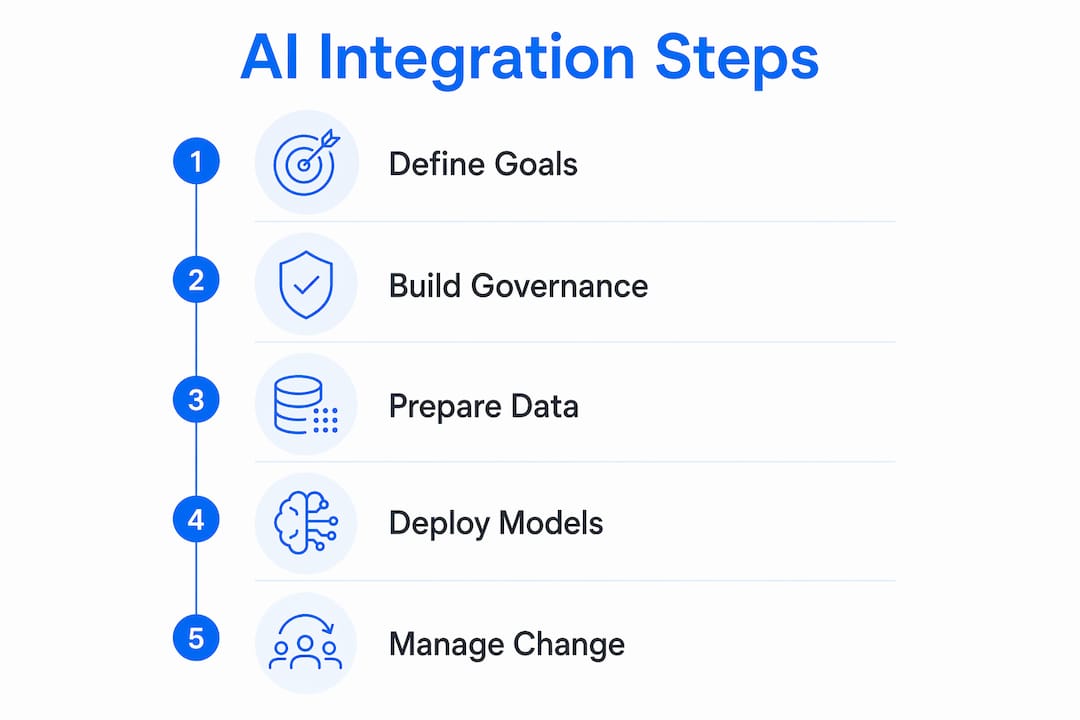
A working AI integration approach rests on five interconnected components. Each one is necessary. None is sufficient on its own.
- Business alignment. Every AI initiative must map to a measurable business outcome, whether that is reducing invoice processing time, improving customer resolution rates, or cutting infrastructure costs. Vague goals like "become more AI-driven" produce vague results.
- People and process redesign. The 70% effort allocation belongs here. Workflows must be redesigned around AI outputs, not just augmented by them. This includes retraining staff, rewriting job responsibilities, and redesigning approval chains.
- Data infrastructure. Clean, accessible, well-governed data is the prerequisite for any AI system that performs reliably. This covers data pipelines, labeling, versioning, and access controls.
- Governance and ethics. Effective AI governance integrates bias mitigation, transparency requirements, and ethical guidelines from the start, not as an afterthought. MIT Sloan's research frames governance as the foundation for long-term adoption, not a compliance hurdle.
- Leadership sponsorship. AI initiatives without a named executive owner consistently stall at the pilot stage. Ownership determines budget, priority, and the authority to drive cross-functional change.
Pro Tip: Build your governance charter before your first production deployment. Retrofitting ethics and compliance controls onto a live system costs three to five times more than designing them in from day one.
Change management deserves its own emphasis. Employees who do not understand why AI is being introduced, or who fear it will eliminate their roles, will find ways to work around it. Communication plans, training programs, and visible quick wins are not soft extras. They are the mechanism by which strategy becomes adoption.
How to assess your organization's AI maturity and readiness for integration
Before committing to a full AI strategy development cycle, organizations need an honest picture of where they currently stand. The Carnegie Mellon Software Engineering Institute describes five AI maturity levels that provide a practical framework for this assessment.
- Exploratory. AI use is ad hoc, driven by individual teams or enthusiasts. No shared infrastructure, no governance, no measurement.
- Implemented. Specific AI tools are in production, but deployments are siloed. Success is anecdotal rather than measured.
- Aligned. AI initiatives connect to business strategy. Governance structures exist. Cross-functional teams share data and metrics.
- Scaled. AI operates across multiple business units with repeatable processes, centralized oversight, and defined KPIs.
- Future Ready. AI is embedded in the operating model. The organization continuously refines its approach based on performance data and emerging capabilities.
Static checklists are insufficient for this kind of assessment. Evidence-based evaluations, which examine actual deployment data, governance documentation, and outcome metrics, give a far more accurate picture of maturity than self-reported surveys.
The most common trap at the Implemented stage is what practitioners call pilot purgatory. Pilots without clear business cases consume resources without producing scalable results. The fix is straightforward: select bounded, repeatable processes with measurable baselines before any pilot begins. If you cannot define what success looks like in advance, the pilot will not teach you anything useful.
Organizations at the Exploratory and Implemented stages should prioritize governance and measurement infrastructure before expanding their AI footprint. Adding more tools to an ungoverned environment does not accelerate maturity. It deepens fragmentation.
What are the best architecture approaches for integrating AI into enterprise systems?
Architecture decisions made early in an AI integration project determine whether the system scales cleanly or becomes a maintenance liability. Three patterns dominate enterprise AI integration in 2026.

Sidecar architecture is the most widely recommended pattern for organizations that cannot afford to modify core systems. Sidecar AI architecture uses event buses and separate AI gateway services to keep core platforms unchanged. The AI component runs alongside the main application, consuming events and returning outputs without touching the primary codebase. This is particularly valuable for legacy ERP and CRM environments where code changes carry high risk.
Event-driven asynchronous integration pairs naturally with the sidecar pattern. Asynchronous event-driven communication prevents AI processing from increasing system latency and isolates AI failure modes from core operations. When an AI service goes down or produces unexpected outputs, the main system continues functioning. This decoupling is not optional at enterprise scale. It is the difference between a recoverable incident and a production outage.
Feature flags and shadow mode deployment give teams the ability to test AI behavior in production without exposing users to its outputs. Integrating AI behind feature flags from day one decouples model performance from system uptime and enables instant rollback. Shadow mode runs the AI model in parallel with existing logic, logging its outputs for comparison without acting on them. This is the safest way to validate model behavior before a full cutover.
| Architecture pattern | Best for | Key trade-off |
|---|---|---|
| Sidecar with event bus | Legacy systems, zero core code changes | Requires mature event infrastructure |
| Feature flags + shadow mode | Gradual rollout, risk-averse teams | Adds operational complexity |
| Proxy and microservice layer | Greenfield or modular architectures | Higher initial build cost |
Pro Tip: Treat AI models as optional dependencies, not core services. Build fallback paths for every AI call so your application degrades gracefully when a model is unavailable or returns low-confidence outputs. A well-designed LLM proxy handles this at the infrastructure layer, removing the burden from individual application teams.
Cost control and latency management deserve explicit attention in the architecture phase. Synchronous AI calls on the critical path of a user-facing request are a common mistake. Move them off the critical path wherever possible, and set hard timeout and cost thresholds at the gateway level before any model goes live.
How to ensure scalable AI adoption through governance and measurement
Fragmented AI systems fail at enterprise scale without standardization and centralized oversight. Governance is the mechanism that prevents fragmentation from compounding as adoption grows.
Effective governance for AI integration in business covers four areas:
- Ownership and accountability. Every AI system in production needs a named owner responsible for its performance, compliance, and retirement. Shared ownership means no ownership.
- KPIs tied to business outcomes. Metrics like model accuracy or inference speed are useful internally, but leadership needs to see cost reduction, cycle time improvement, or revenue impact. Define both layers before deployment.
- Bias and ethics review. Ethical AI governance creates trust among employees, customers, and regulators, which accelerates enterprise adoption rather than slowing it. Build review checkpoints into the deployment pipeline, not just the initial design phase.
- Interoperability standards. Teams that build AI integrations in isolation create systems that cannot share data, cannot be centrally monitored, and cannot be replaced without significant rework.
"A strategic AI roadmap aligned with business objectives is the single most reliable way to prevent fragmented and ineffective AI projects from consuming resources without producing value."
Change management is the execution layer for governance. Employees need to understand what AI is doing in their workflows, why it was introduced, and how to escalate concerns. Organizations that skip this step see adoption rates plateau well below projections, regardless of how well the technology performs. The enterprise AI onboarding guide from Deepour covers the first 30 days of structured rollout in detail, including communication templates and training cadences.
What practical steps should organizations take to build an AI integration strategy?
A repeatable process for building and executing an AI implementation strategy follows six steps. Each step produces a concrete output, not just a decision.
- Map workflows and identify pain points. Document the processes where AI could reduce manual effort, improve accuracy, or accelerate throughput. Prioritize by frequency and business impact, not by technical novelty.
- Score use cases by impact and feasibility. Build a simple two-axis matrix. High-impact, high-feasibility use cases go first. Avoid starting with transformational use cases that require significant data work or process redesign before they can be piloted.
- Define baseline metrics before any pilot begins. Measure current performance on the target process. Without a baseline, you cannot demonstrate improvement, and you cannot make a credible case for scaling.
- Run a governed pilot with a defined review cadence. Set a fixed evaluation window, typically 60 to 90 days, with weekly check-ins. Involve end users from day one. Their feedback surfaces integration problems that technical teams miss entirely.
- Evaluate and decide: scale, iterate, or stop. A pilot that does not meet its baseline targets is not a failure. It is data. Use it to refine the use case selection criteria for the next cycle.
- Build a repeatable operating model. Whether centralized or federated, the operating model defines how new AI use cases are proposed, evaluated, approved, and monitored going forward. This is what separates organizations that scale AI from those that stay in pilot mode indefinitely.
Pro Tip: Publish your AI use case scoring criteria internally. When teams understand how decisions are made, they submit better proposals and stop pursuing shadow AI projects that bypass governance.
A governed AI rollout process, as Deepour describes it, applies the 10-20-70 principle at every phase: technology decisions are fast, infrastructure decisions are deliberate, and people and process decisions get the most time and attention.
Key takeaways
A successful AI integration strategy allocates the majority of its effort to people, processes, and governance, not to model selection or infrastructure build.
| Point | Details |
|---|---|
| Strategy before tools | Define business outcomes and governance before selecting any AI model or vendor. |
| The 10-20-70 rule | Allocate 70% of effort to people and process redesign, 20% to infrastructure, and 10% to algorithms. |
| Maturity assessment first | Use evidence-based maturity models to identify your current stage before expanding AI deployments. |
| Architecture decouples risk | Sidecar patterns, feature flags, and async integration protect core systems from AI failure modes. |
| Governance enables scale | Centralized oversight, clear ownership, and ethical review are prerequisites for moving beyond pilot stage. |
The tension between speed and stability in AI integration
The pressure to ship AI fast is real. Boards want results. Competitors are announcing capabilities. The temptation is to skip the maturity assessment, skip the governance charter, and go straight to production with whatever model performs best in a demo.
I have seen this play out enough times to say with confidence: the organizations that move fastest in year one almost always spend year two cleaning up fragmentation, rewriting integrations, and explaining to regulators why their AI system produced outputs nobody can account for. Speed without architecture is technical debt at scale.
What actually works is a short, disciplined discovery phase, typically four to six weeks, that produces a use case map, a baseline measurement, and a governance charter. That investment pays back in every subsequent phase because decisions get made faster, pilots get evaluated honestly, and scaling happens without the rework cycle.
The other pattern worth naming is the tendency to treat AI integration as a project with an end date. It is not. Models deprecate. Business requirements shift. New capabilities emerge that invalidate last year's architecture decisions. The organizations that sustain AI value over time are the ones that build a continuous review cycle into their operating model from the start, not the ones that declare victory after the first successful deployment.
— Shawn
How Deepour supports scalable AI integration for enterprise teams

Deepour is built for exactly the architectural and governance challenges described in this article. The platform provides a unified AI model gateway that handles provider routing, failover, policy-based access controls, and usage analytics across open-weight and frontier models through a single API. For enterprise teams managing multiple AI use cases across business units, Deepour's centralized control plane prevents the fragmentation that kills scalability. Features like SOC 2 compliance, role-based access, and private endpoints address the governance requirements that regulated industries cannot negotiate away. If your organization is moving from pilot to production or building the operating model that will govern AI at scale, Deepour's enterprise platform is designed for that transition.
FAQ
What is an AI integration strategy in simple terms?
An AI integration strategy is a formal plan that connects AI capabilities to specific business goals, covering technology, people, processes, and governance. It defines how AI is selected, deployed, measured, and scaled across an organization.
How is an AI integration strategy different from an AI project plan?
A project plan covers a single deployment with a defined start and end. An AI integration strategy governs the entire portfolio of AI initiatives, including how use cases are prioritized, how governance works, and how the organization builds repeatable capability over time.
What is the biggest risk in AI integration without a strategy?
Pilot purgatory is the most common outcome: organizations run multiple disconnected pilots that never scale because there is no shared infrastructure, no governance, and no clear criteria for what success looks like.
How long does it take to build an AI integration strategy?
A foundational strategy, covering use case prioritization, governance structure, and architecture principles, typically takes four to eight weeks for a mid-size enterprise. Execution is ongoing, with quarterly reviews recommended to account for model changes and shifting business priorities.
What role does governance play in AI integration?
Governance is the foundation for long-term AI adoption, not a compliance overhead. It establishes ownership, defines ethical boundaries, sets performance standards, and creates the trust among employees and regulators that allows AI to scale without repeated crises.